

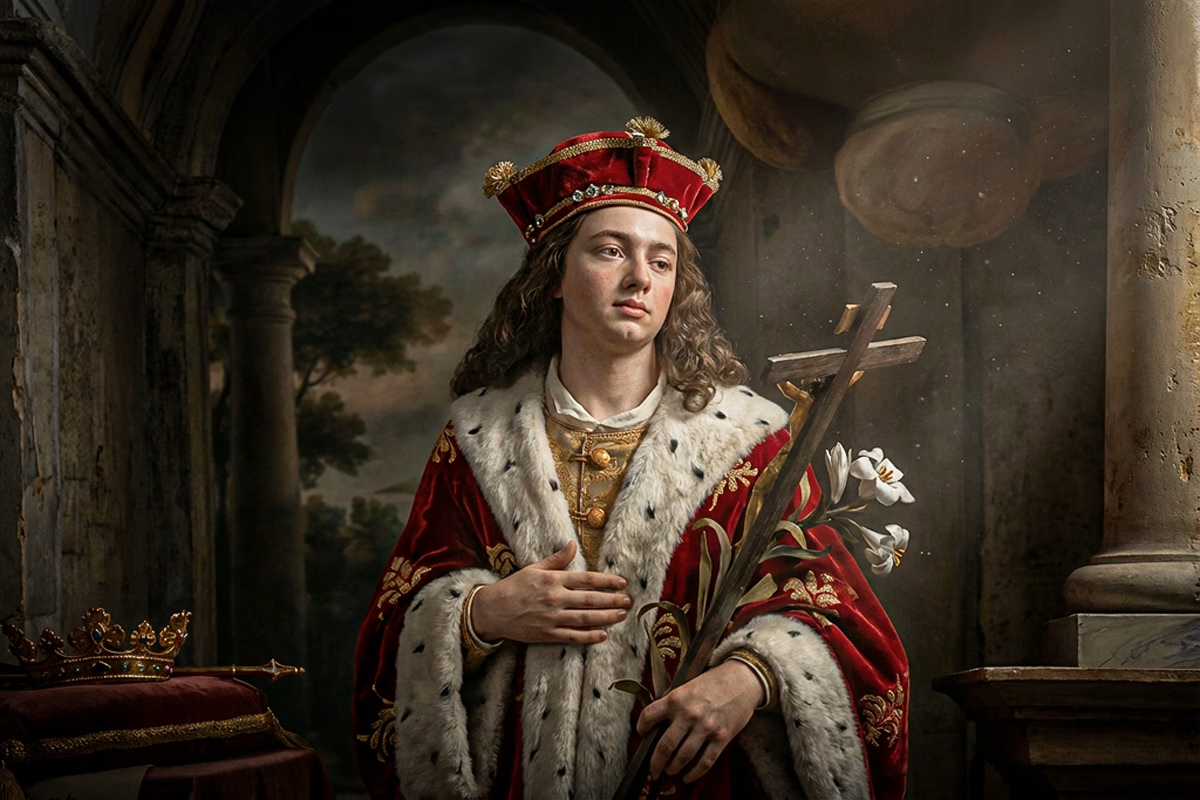
Saint Casimir: Holiness Above Power
Saint Casimir (1458–1484), known as Casimir Jagiellon, was a Polish-Lithuanian royal prince who became one of the most beloved saints of Eastern Europe for his extraordinary piety amid princely privilege.
The third son of King Casimir IV of Poland and Grand Duke of Lithuania and Queen Elizabeth of Austria, he was born in Kraków and educated by the renowned historian John Dlugosz, who nurtured his deep Catholic faith, love of learning, and sense of justice.
Leadership Lessons for Catholic Leaders
From adolescence, Casimir embraced a life of rigorous asceticism: he prayed long hours (often rising at night for vigils), slept on the bare floor, fasted frequently, wore a hair shirt, and devoted himself to serving the poor and sick. He vowed perpetual chastity and rejected all courtly vanities and ambitions.
At age 13, he was briefly installed as King of Hungary by his father but returned after military failure, thereafter refusing involvement in unjust wars. He governed Poland capably and fairly during his father’s absences (1481–1483). When urged to marry for political alliances, he firmly declined, choosing instead a consecrated single life dedicated to God.
His health, undermined by severe penances, failed; he died of lung disease at age 25 on March 4, 1484, in Grodno (modern Belarus). Miracles reported at his tomb in Vilnius Cathedral led to rapid veneration. He is traditionally credited with composing or inspiring the hymn “Omni die dic Mariae” (“Daily, Daily Sing to Mary”).
Canonized in the early 16th century (around 1521–1522), He is patron saint of Poland, Lithuania, and Lithuanian youth.
Reflection Questions & Personal Application
Casimir’s life teaches that holiness is possible even in the highest ranks: choose purity, prayer, and charity over power; live with integrity; and prioritize eternal values over temporal glory.