
Maintenance: A Catholic Virtue, Not a Dirty Word
In Catholic circles today, few words carry the sting of “maintenance” when applied to a parish. It evokes images of a dying congregation: endless fundraisers for the leaking roof, a shrinking roster of aging parishioners, sacraments administered but rarely leading to transformed lives, and a pastor buried in boiler repairs rather than baptisms or Bible studies. Critics contrast this with vibrant “mission-driven” parishes that evangelize, grow, and set the world on fire. The dichotomy is real and often necessary. Yet as faithful Catholics, we must beware of a false opposition that risks despising the ordinary, the sustaining, and the incarnational. Maintenance, rightly understood, is not the enemy of mission, it is its humble partner.
The Negative Connotation—and Its Limits
The critique is familiar and frequently justified. Many parishes have slipped into a “maintenance mode” where preserving buildings, schedules, and traditions eclipses the Great Commission (Matthew 28:19). Cardinal Timothy Dolan and others have warned against tending the Church like a museum. Pastoral plans across dioceses urge a shift “from maintenance to mission.” When “maintenance” becomes code for complacency, inward focus, or fear of change, it deserves challenge.
But the word itself is not the problem. To maintain is to sustain, to care for, to keep in good order what has been entrusted to us. In a throwaway culture, faithful stewardship of the gifts God has given, physical plants, liturgical beauty, sacramental life, doctrinal clarity, is profoundly countercultural. A parish that neglects maintenance quickly becomes unable to serve anyone. The roof collapses, the heat fails, the liturgy grows sloppy, formation withers. Mission without maintenance is a spark that burns out; maintenance without mission is a well-kept tomb.
Mission without maintenance is a spark that burns out; maintenance without mission is a well-kept tomb.
Jesus and the Work of Maintenance
Our Lord Himself modeled both. Jesus preached the Kingdom, healed the sick, and called disciples to radical mission. Yet He also engaged in what we might call maintenance:
- He regularly attended synagogue on the Sabbath (Luke 4:16), sustaining the rhythms of worship.
- He drove out the moneychangers from the Temple not to abolish sacred space, but to restore its proper order and dignity (John 2:13-16).
- He instructed Peter to “feed my sheep” (John 21:15-17), a charge of ongoing pastoral care and upkeep of the flock.
- In the parables, the wise steward is the one who maintains the household well until the master returns (Luke 12:42-48).
Even the Incarnation itself is divine maintenance: God entering history to redeem, restore, and sustain fallen creation. Christ upholds the universe by His word (Hebrews 1:3; Colossians 1:17). The Church continues this work, preserving the deposit of faith, the sacraments, and the communion of saints across generations. Saints like St. Benedict built monasteries that preserved learning, liturgy, and agriculture through centuries of chaos. Their “maintenance” enabled later missionary explosions.
The Four Seasons Analogy: Excellence in the Ordinary
Consider the Four Seasons hotel chain. Guests do not praise it merely for grand initiatives or flashy innovations. They return because the rooms are immaculate, the service consistent, the details flawless, and the staff quietly attentive. Behind the luxury lies relentless maintenance: daily cleaning, systems checked, staff training, preventive repairs. This unseen work makes possible an extraordinary guest experience. No one accuses Four Seasons of being “maintenance-minded” in a pejorative sense; the care is what enables their mission of hospitality at the highest level.
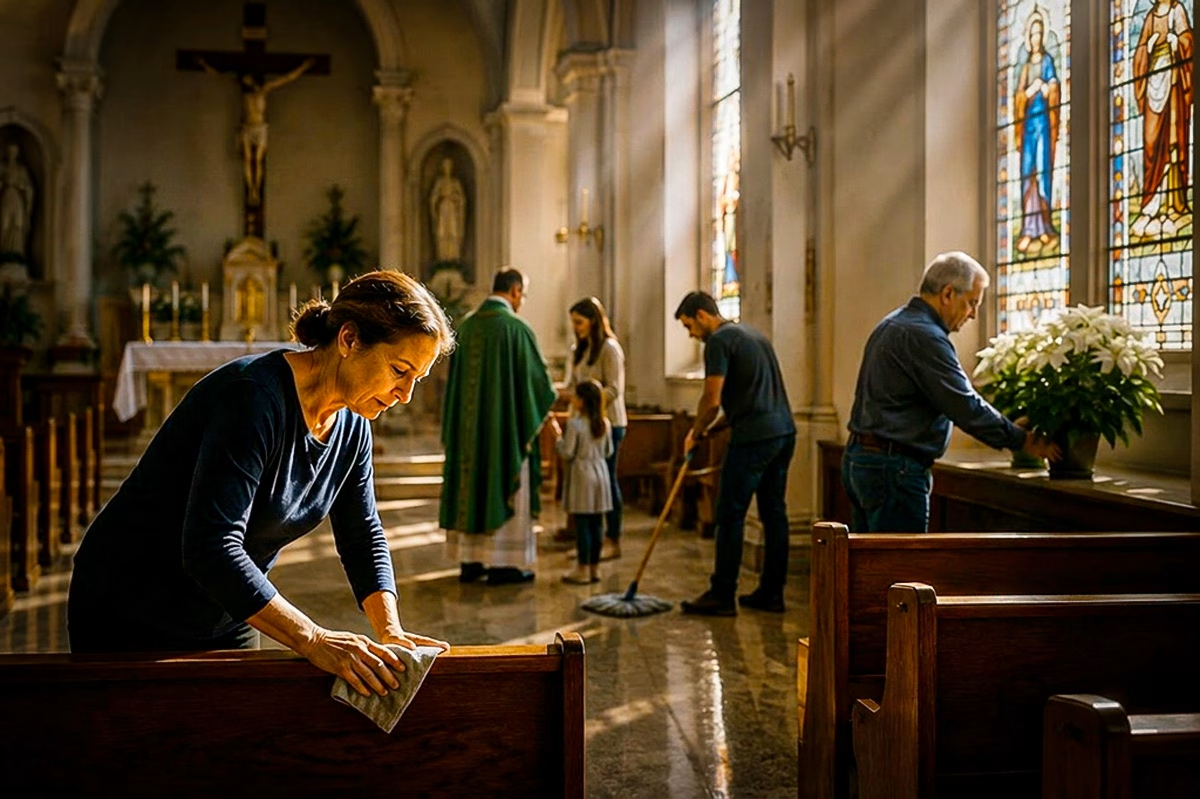
A parish can be the same. A beautifully maintained church building, reverent liturgy, reliable catechesis, and caring pastoral presence create the stable environment where souls encounter Christ. Thriving ministry flows from this foundation. The spectrum is not binary but a healthy tension: maintenance serves mission, and mission renews what is maintained.
A beautifully maintained church, reverent liturgy, and caring pastoral presence create the environment where souls encounter Christ.
Judging the Spectrum Honestly and Responding Positively
How does a parish discern where it stands without defensiveness or denial?
- Pray and Examine with Humility: Begin with the Holy Spirit. Use tools like parish self-assessments from dioceses or resources such as Divine Renovation by Fr. James Mallon. Ask: Are we primarily preserving the status quo out of fear, or stewarding gifts for fruitfulness? Are new disciples being made? Are families nourished? Is the poor served? Metrics of vitality include not only Sunday Mass attendance but baptisms, confessions, marriages, vocations, outreach, and missionary discipleship.
- Celebrate Faithful Maintenance: Publicly affirm the quiet heroes, those who mow lawns, balance budgets, polish brass, teach CCD, visit the sick. Frame maintenance as love in action. A well-kept parish signals that faith matters enough to care for.
- Integrate Mission into Every Act of Care: Paint the hall while planning evangelization nights in it. Repair the organ to lift hearts in worship that sends people forth. Budget for facilities with an eye toward welcoming the unchurched. Maintenance becomes missional when ordered toward encounter with Christ.
- Avoid Defensiveness; Embrace Conversion: If labeled “maintenance,” resist the temptation to lash out or double down. Instead, audit honestly. Some parishes need structural reform. Others are already healthier than critics realize. Leadership should cast vision: “We maintain this beautiful inheritance so we can more boldly proclaim the Gospel.”
- Balance the Seasons: Like the liturgical year, or the actual seasons, parishes cycle through times of intense mission (planting, harvesting) and necessary upkeep (pruning, resting). A parish in a rural declining area may rightly focus on faithful presence and care for the remnant. Urban or suburban ones may emphasize growth. Wisdom discerns the context.
In the end, the Church is neither a museum nor a startup. She is the Bride of Christ, called to both preserve the faith once delivered to the saints (Jude 1:3) and to make all things new. Maintenance, when infused with love and ordered to mission, is not mediocrity, it is fidelity. Let us maintain well, so that when the Master returns, He finds us watchful, fruitful, and ready.
Deacon Patrick Stokely
Saints Peter and Paul Parish
West Chester, PA