
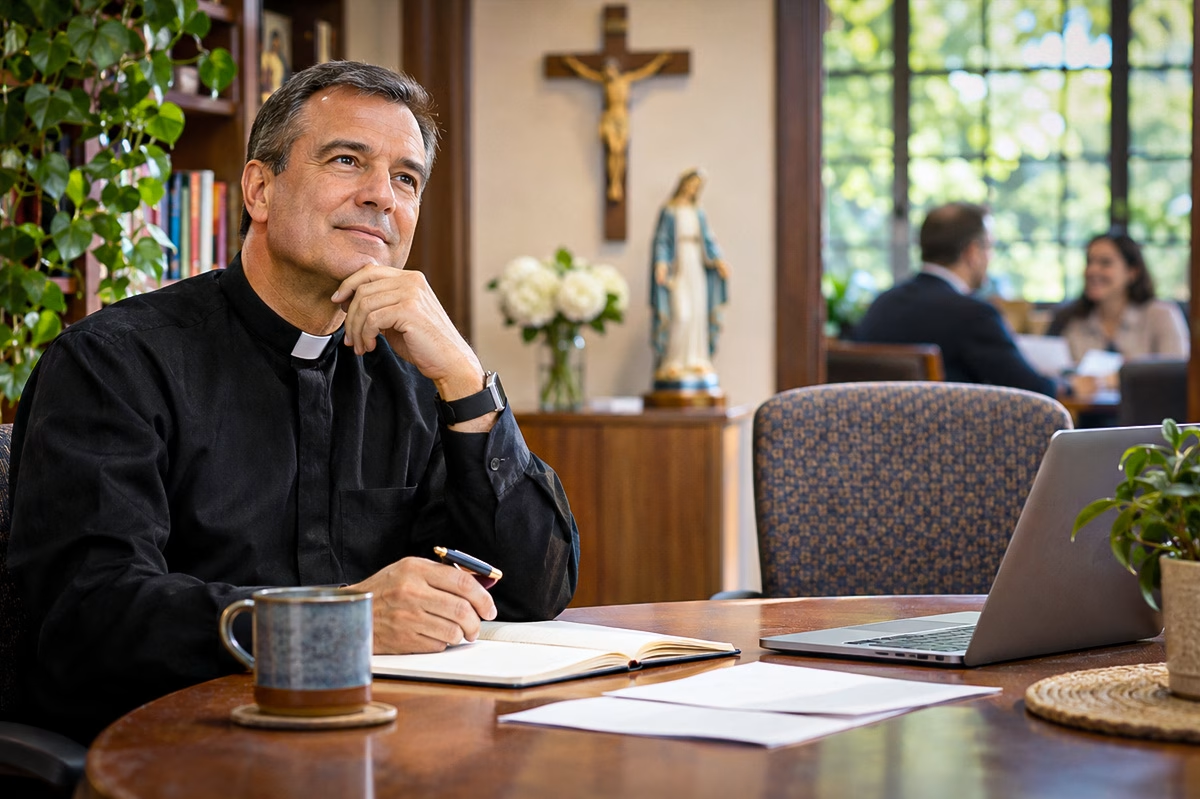
A 360-degree feedback process offers a Catholic pastor a structured, multi-perspective mirror for leadership growth and self-awareness at a time when the demands of parish life, declining vocations, complex diocesan expectations, and shifting cultural realities place unprecedented pressure on pastoral leadership. In most parish settings the pastor occupies a singular position: he is simultaneously spiritual father, chief executive, liturgical presider, pastoral counselor, and public face of the local Church. That centrality can produce both isolation and a limited feedback loop. Parishioners may hesitate to speak candidly; staff may filter comments through concern for employment or relationship; councils may focus on discrete agenda items rather than the pastor’s overall effectiveness. A carefully designed 360 process interrupts that pattern by gathering confidential, structured input from the very people who experience the pastor’s leadership daily and from those who hold him accountable within the larger Church.
The process typically invites feedback from the parish staff, members of the finance and pastoral councils, school faculty and administration where a parish school exists, key ministry leaders, and selected diocesan figures such as the dean or bishop. Because these groups stand in different relational positions to the pastor, their observations complement one another. Staff experience the pastor’s day-to-day management style, decision-making tempo, emotional regulation under stress, and capacity to set clear expectations. Finance-council members observe how he handles resource allocation, long-term planning, and fiduciary responsibility. Pastoral-council members see how he animates the mission, listens to the community, and stewards the parish’s pastoral priorities. School faculty notice the consistency between the pastor’s public statements about Catholic identity and the practical support given to the school. Ministry leaders register whether the pastor empowers or bottlenecks volunteer efforts. Diocesan leadership, by contrast, can speak to alignment with diocesan priorities, the pastor’s reputation beyond the parish boundaries, and the health of the relationship between parish and diocese. When these voices are synthesized, the pastor receives a more complete portrait than any single constituency could provide.
One of the most valuable outcomes is the illumination of blind spots, both the unrecognized strengths that can be more fully leveraged and the unintended consequences of otherwise well-intentioned behaviors. Many pastors possess significant gifts that remain under-utilized because they themselves do not see the impact. A pastor who is consistently described by staff and ministry leaders as a gifted listener and a calm presence in crisis may not realize how rare and stabilizing that quality is; once named, he can deliberately create more space for that gift rather than allowing administrative tasks to crowd it out. Another pastor may learn that his capacity to articulate a compelling vision is widely admired, yet he has not translated that vision into concrete, shared goals with clear ownership. The 360 makes the strength visible so that it can be intentionally deployed.
A carefully designed 360 process interrupts that pattern by gathering confidential, structured input from the very people who experience the pastor’s leadership daily.
Equally important is the discovery of unintended consequences. A pastor who prides himself on accessibility and an open-door policy may learn that staff experience the same behavior as a lack of boundaries that fragments their workday and undermines their ability to complete projects. A pastor who believes his direct style demonstrates honesty and urgency may discover that council members and school faculty interpret the same style as dismissive or anxiety-producing, causing them to withhold information or disengage. A pastor committed to collaborative decision-making may find that his practice of repeatedly reopening settled questions creates uncertainty and slows momentum. These insights are rarely available through casual conversation; they emerge when multiple observers independently note the same pattern and when the feedback is delivered in a facilitated, non-punitive setting. Awareness of the gap between intention and impact is the necessary first step toward behavioral change.
Feedback from diocesan leadership adds a further dimension of awareness. A dean or bishop can place the pastor’s local effectiveness within the larger context of diocesan mission, priestly fraternity, and the long-term sustainability of the parish. They may observe, for example, that a pastor’s strong relational gifts within the parish are not matched by timely communication with the chancery, creating unnecessary friction. They may note that a pastor’s reluctance to address conflict among staff is visible to neighboring pastors and affects the deanery’s ability to collaborate. Because this input comes from those who hold formal ecclesial authority, it also helps the pastor calibrate his leadership against the expectations of the Church he serves. When diocesan feedback is integrated with parish-level feedback, the pastor gains a clearer sense of how his ministry is experienced both inside and outside the parish boundaries.
Awareness of the gap between intention and impact is the necessary first step toward behavioral change.
The raw volume of feedback, however, is not itself transformative. Most 360 instruments generate a substantial amount of data, quantitative scores across leadership competencies and qualitative comments that can number in the dozens. Without disciplined processing, the pastor can be overwhelmed, defensive, or uncertain about where to focus. Working with a trained coach is therefore essential. The coach helps the pastor distinguish between themes that appear across multiple rater groups and isolated comments that may reflect individual preferences. Together they identify two or three high-leverage goals whose achievement would meaningfully increase the pastor’s effectiveness. These goals are not generic aspirations; they are specific, observable shifts grounded in the feedback. A pastor who learns that he is perceived as unavailable to staff might set a goal of establishing a predictable weekly one-on-one rhythm with each direct report and of protecting those appointments from interruption. A pastor whose vision is admired but not operationalized might commit to co-creating, with the pastoral council, a one-page set of annual priorities with named owners and review dates. A pastor who discovers that his conflict-avoidance leaves unresolved tensions might practice a structured approach to difficult conversations, beginning with lower-stakes issues and gradually addressing more significant ones. Because the goals are few and tightly linked to the feedback, the pastor is more likely to experience early progress, which in turn reinforces the value of the process.
Sustained growth also requires an accountability partner, someone who will walk with the pastor over months rather than weeks. This person is ideally a trusted peer, a spiritual director with leadership experience, or a fellow pastor who understands both the demands of parish life and the specific goals the pastor has chosen. The accountability partner’s role is not to supervise or evaluate but to provide regular, confidential conversation about progress, setbacks, and the emotional terrain of change. Pastors often report that the most difficult part of leadership development is not acquiring new skills but practicing them under the ordinary pressures of parish life, unexpected funerals, budget shortfalls, personnel crises, and the constant demand for availability. An accountability partner helps the pastor notice when old patterns reassert themselves, celebrates incremental gains that might otherwise go unremarked, and offers perspective when the pastor feels discouraged. In a vocation that can be lonely, this companionable presence converts solitary intention into shared practice.
A Catholic pastor who engages a 360 process gains a clearer view of the leadership he actually exercises rather than the leadership he intends.
From a leadership-growth perspective, the cumulative effect of the 360 process, coaching, and accountability is a measurable increase in self-awareness that translates into more effective pastoral leadership. Self-aware pastors make better decisions because they understand how their strengths and limitations affect others. They build stronger teams because staff and volunteers experience greater clarity, consistency, and psychological safety. They steward resources more wisely because they receive unfiltered information about the practical consequences of their choices. They relate more fruitfully to diocesan leadership because mutual expectations are clearer. Over time, these shifts strengthen the parish’s capacity to fulfill its mission: the proclamation of the Gospel, the celebration of the sacraments, the formation of disciples, and the service of the poor. The pastor himself experiences greater congruence between his deepest vocational desires and the daily exercise of his ministry, reducing the internal friction that often accompanies unexamined leadership habits.
The process is not without cost. It requires the pastor’s willingness to be vulnerable, the careful selection and preparation of raters, skilled facilitation, and a subsequent investment of time in coaching and accountability. When those conditions are met, however, the return is substantial. A Catholic pastor who engages a 360 process gains a clearer view of the leadership he actually exercises rather than the leadership he intends. He discovers strengths he can more fully offer and unintended consequences he can more deliberately address. Supported by a coach and accompanied by an accountability partner, he converts insight into two or three focused changes that increase his effectiveness. In doing so, he models for the entire parish community the humility and intentionality that Christian leadership requires, and he equips himself to shepherd the people entrusted to him with greater wisdom, freedom, and pastoral fruitfulness.
Deacon Patrick Stokely
Saints Peter and Paul Parish
West Chester, PA