

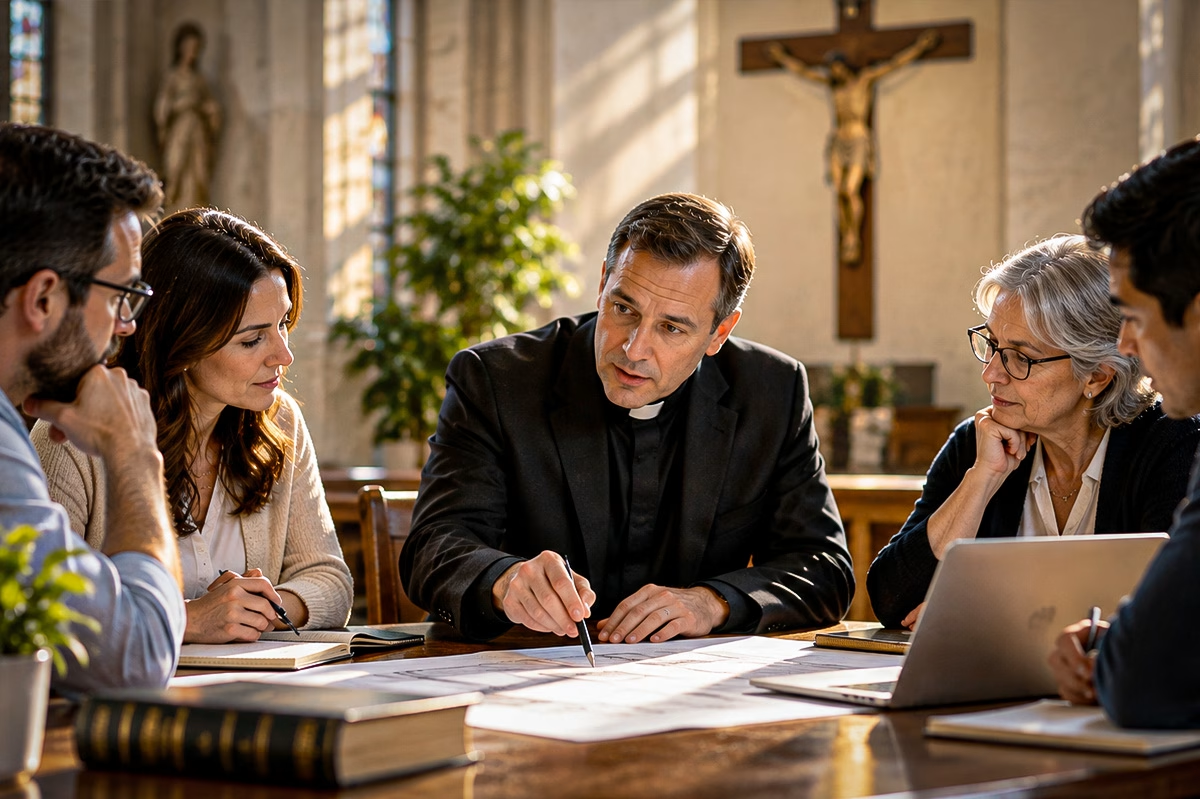
Catholic leaders, bishops, pastors, and those who share responsibility for dioceses and parishes, face a quiet but decisive challenge. The Church is not a corporation, yet it must organize people, resources, and time toward a supernatural end: the salvation of souls and the building up of the Body of Christ. Good intentions and personal holiness, while indispensable, do not automatically produce clarity, accountability, or sustained fruitfulness. Organizational design matters. Yet structure alone is never enough. The deeper requirement is the careful definition of roles and the appointment of people who bring both competence and, more importantly, the interior disposition that serves the mission.
This is not a choice between structure and people. It is a both/and. Clear structures without the right people become empty scaffolding. Gifted and well-intentioned people without clear roles and shared expectations often produce friction, burnout, and mission drift. The pastoral task is to hold both realities together with deliberate care. Jesus himself models this pattern throughout the Gospels.
Why Structure Without Clear Role Definition Fails
Many Church organizations inherit or create organigrams that look orderly on paper. Boxes are drawn, titles assigned, and reporting lines sketched. The problem arises when those boxes remain vague. “Director of Evangelization,” “Parish Administrator,” “Coordinator of Youth Ministry,” or even “Vicar General” can mean very different things depending on the personality who currently occupies the office or the unstated assumptions of the one who appointed them.
When roles lack precise definition, purpose, primary responsibilities, decision rights, relationships with other roles, and measurable contributions to the mission, several predictable dysfunctions follow. Overlap creates turf battles or duplicated effort. Gaps leave essential work undone. Accountability becomes personal rather than structural. Staff and volunteers, unsure of boundaries, either overstep or underperform. Leaders then spend disproportionate energy mediating conflicts that clearer design would have prevented.
Jesus consistently avoided this ambiguity. He chose the Twelve after a night of prayer and named them apostles with a defined purpose: to be with him and to be sent out to preach, heal, and cast out demons (Mark 3:13–19; Matthew 10). He gave them concrete instructions on travel, lodging, proclamation, and response to rejection. He later appointed seventy-two others with similarly precise directives (Luke 10:1–12). The Great Commission itself is a model of role clarity: authority is declared, the task is specified (make disciples, baptize, teach), and the promise of presence is attached (Matthew 28:18–20). Scripture and tradition offer no license for organizational vagueness. Clarity of role served the mission; it did not compete with it.
Clear structures without the right people become empty scaffolding.
Competence Is Necessary; Mindset Is Decisive
Structure, even when well defined, remains inert without the right people. Technical skill matters. A finance officer must understand budgets. A communications director must write clearly. Competence protects the community from avoidable harm.
Yet skill alone is insufficient, and sometimes dangerous. A highly competent person who lacks the right interior orientation can advance efficiency while quietly undermining the mission. The decisive criterion is mindset: the settled disposition of the heart and mind that aligns personal ambition, work habits, and relational style with the Church’s purpose. This includes a lived conviction that success is measured by fidelity to Christ, willingness to subordinate personal preference to legitimate authority, capacity for collaboration, interior freedom from the need to control, and habitual recourse to prayer.
Jesus selected fishermen, a tax collector, and a zealot, not the most credentialed, but men willing to leave everything. He repeatedly tested and purified their mindset. When Peter confessed Jesus as Messiah and received the unique role of the rock with the keys of the kingdom (Matthew 16:13–20), Jesus immediately corrected him for thinking in merely human terms. After the resurrection he restored Peter by probing his love three times before recommissioning him to feed the sheep (John 21:15–19). When James and John sought seats of honor, Jesus did not abolish leadership; he redefined its meaning as self-emptying service (Mark 10:35–45). At the Last Supper he washed the disciples’ feet and commanded them to do likewise, joining clear example to the required interior disposition (John 13). Structure without the servant heart becomes worldly power; the servant heart without clear commissioning remains vague.
Structure without the servant heart becomes worldly power; the servant heart without clear commissioning remains vague.
Both/And in Practice
The practical counsel for bishops and pastors is therefore twofold and simultaneous.
First, invest the time to define roles with precision. Begin with the mission of the diocese or parish. Ask what concrete contribution this role must make. Translate the answer into a short description covering purpose, primary accountabilities, decision rights, key relationships, and indicators of fruitfulness. Review existing descriptions periodically. When a position becomes vacant, resist the pressure to fill it quickly; refine the design first.
Second, treat the search as a discernment of both competence and mindset. Skills can be tested. Mindset requires deeper attention: conversations about vocation and motivation, observation of how candidates speak about previous collaborators, inquiry into habits of prayer, and listening for signs of entitlement or residual ambition. Involve trusted advisors who share the same criteria. The goal is not perfect people but those whose strengths fit the role and whose interior orientation will reinforce the culture of mission.
Once people are in place, the both/and continues. Clear role definitions make honest feedback possible. Regular review of both individual performance and the suitability of the role design keeps the organization adaptive. When someone proves to lack the necessary mindset despite good intentions, the difficult decision to make a change can be grounded in the objective requirements of the mission.
The goal is not perfect people but those whose strengths fit the role and whose interior orientation will reinforce the culture of mission.
Pastoral Realities and Temptations
Common temptations undermine this approach: the desire to avoid conflict by leaving roles undefined or retaining familiar people whose contribution no longer serves; the wholesale importation of corporate models without translating them into ecclesial logic; and the assumption that personal holiness in the leader substitutes for organizational clarity. It does not.
Jesus held structure and heart together without compromise. He defined roles with precision, chose and formed people more for disposition than worldly skill, and never treated either element as self-sufficient. That remains the pattern.
Conclusion
Organizational structure without clear role definition is a form of negligence. Filling positions with skilled people who lack the mindset of mission is a subtler form of the same. The Catholic leader is called to both: to design structures that serve the mission with clarity and justice, and to appoint and form people whose competence is ordered by a deeper interior yes to Christ and His Church. When these two realities are held together, as Jesus himself modeled, the result is not mere efficiency. It is an organization more capable of becoming what it is meant to be: an instrument of grace in which each member, knowing his or her place and living from the right center, contributes to the building up of the whole in love.
Deacon Patrick Stokely
Saints Peter and Paul Parish
West Chester, PA