

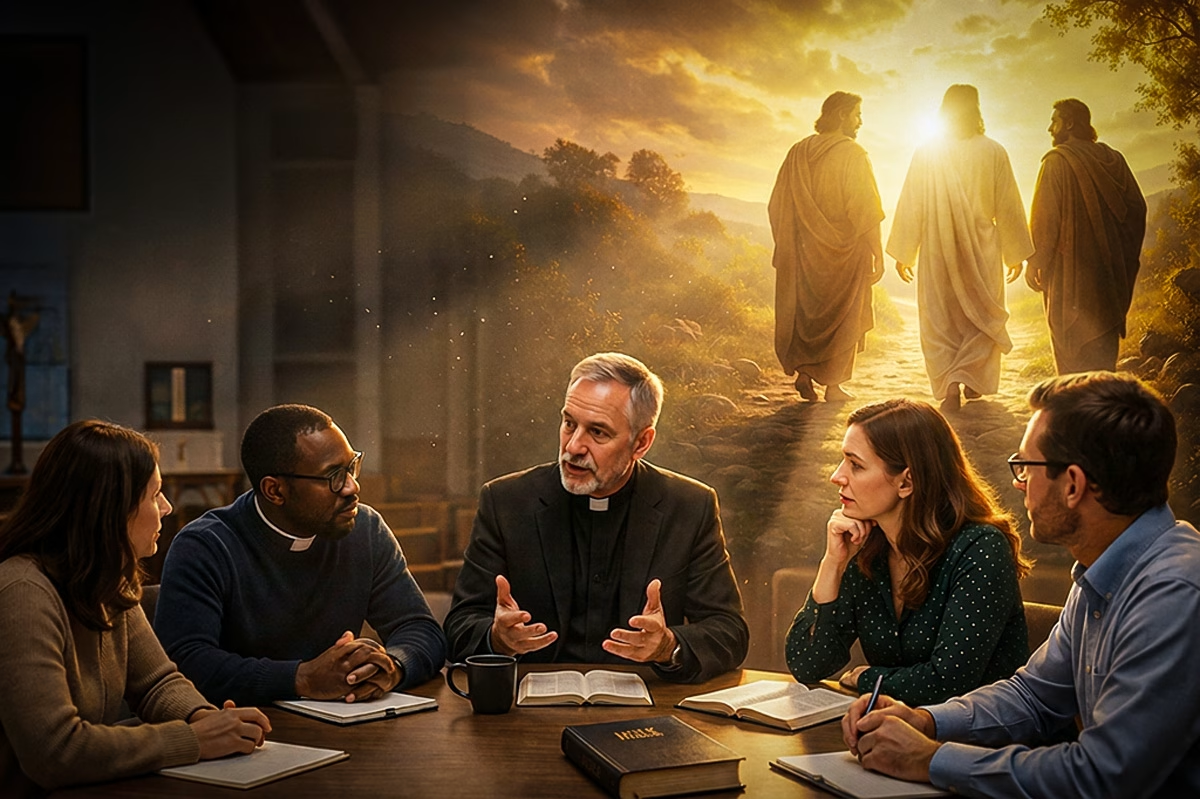
In the vocabulary of contemporary Church life, few words have been stretched, twisted, and ultimately hollowed out quite like collaboration. Once a sturdy term denoting genuine partnership in mission, it has become a reflexive incantation invoked at every staff meeting, every planning session, every moment of tension. “We need more collaboration,” the refrain goes, often delivered with the quiet expectation that no decision will be made, no direction set, until every voice has been heard, every objection aired, and every possible objection neutralized. What began as a tool for communion has too often been weaponized as a shield against accountability, a delay tactic dressed up as virtue, or a polite way of saying, “No one is really in charge.”
This misuse is not merely annoying; it is corrosive. In parishes and diocesan offices, it can flatten decisive leadership into perpetual consultation. It turns urgent pastoral needs of forming the young, serving the poor, proclaiming the Gospel without compromise, into committee exercises where the boldest vision is the first casualty. The word is brandished to imply that any exercise of authority is somehow un-pastoral, un-synodal, or even un-Christian. Yet the Gospels themselves offer a far more demanding and liberating vision.
Collaboration is not the search for consensus; it is the alignment of hearts and hands around a vision already received.
True collaboration in the Church is never an end in itself. It is always a means and it is always subordinate to something greater: the mission given by Jesus Christ. The Lord did not gather the Twelve for endless focus groups. He called them, formed them, and then sent them, two by two, with clear authority and a single message: “The kingdom of God is at hand” (Mk 6:7-13). Their partnership was real, their mutual support essential, but it flowed from a shared obedience to the Father’s will revealed in the Son. Collaboration, in this biblical sense, is not the search for consensus; it is the alignment of hearts and hands around a vision already received.
Jesus Himself modeled this with unflinching clarity. He collaborated deeply with those who accepted the demands of the Kingdom, with Peter, James, and John on the mountain; with the women who traveled with Him; with the seventy-two sent out to prepare His way. But when the scribes and Pharisees approached, He did not convene a working group. He did not soften His teaching to achieve buy-in. He spoke with authority, “You have heard that it was said… but I say to you” (Mt 5:21-22), and when they plotted against Him, He did not negotiate. He confronted, He cleansed the Temple, He wept over Jerusalem, but He never surrendered the mission to committee. There were moments, in other words, when collaboration was not on the table because the truth was not negotiable.
This is the redefinition we desperately need in parish and diocesan staff rooms today. Collaboration is not the default setting for every decision. It is a disciplined, occasional practice reserved for those undertakings that genuinely require the complementary gifts of the community such as developing a new evangelization initiative, discerning how best to serve the materially poor, or designing formation programs that form both mind and heart. Even then, it must begin from a common foundation: fidelity to the Gospel, loyalty to the Church’s magisterium, and a shared recognition that the pastor or bishop bears the charism of governance. Without that foundation, what passes for collaboration quickly becomes paralysis by politeness or the subtle tyranny of the loudest voice.
The Church does not collaborate to discover her mission—she collaborates because she has already received it.
Leaders, be they pastors, deacons or lay leaders, must reclaim the courage to lead decisively when the moment demands it. Not every budget line, not every liturgical choice, not every personnel decision is a “collaboration opportunity.” Some realities require the clear and charitable exercise of authority rooted in prayer and accountability to Christ. The staff member who hides behind “We need more collaboration” when a decision has already been prayerfully made is not fostering communion; he or she is evading responsibility.
The genius of the Gospel model is that it liberates us from both autocracy and anarchy. Jesus gives His Church, apostles who govern and a people who participate. Collaboration flourishes precisely when it is bounded, bounded by the Word of God, bounded by the living tradition, bounded by the concrete mission of the local Church. When that mission is clear, collaboration becomes a joy rather than a burden: the joy of disciples who know where they are going together because they are following the One who has already gone ahead of them.
Let us, then, retire the reflexive use of the word. Let us speak it sparingly, reverently, and only when the vision is first anchored in Jesus Christ. For in the end, the Church does not collaborate to discover Her mission. She collaborates because She has already received it, from the lips of the Lord who both called His disciples to walk with Him and, when necessary, walked alone to the Cross.
Deacon Patrick Stokely
Saints Peter and Paul Parish
West Chester, PA