

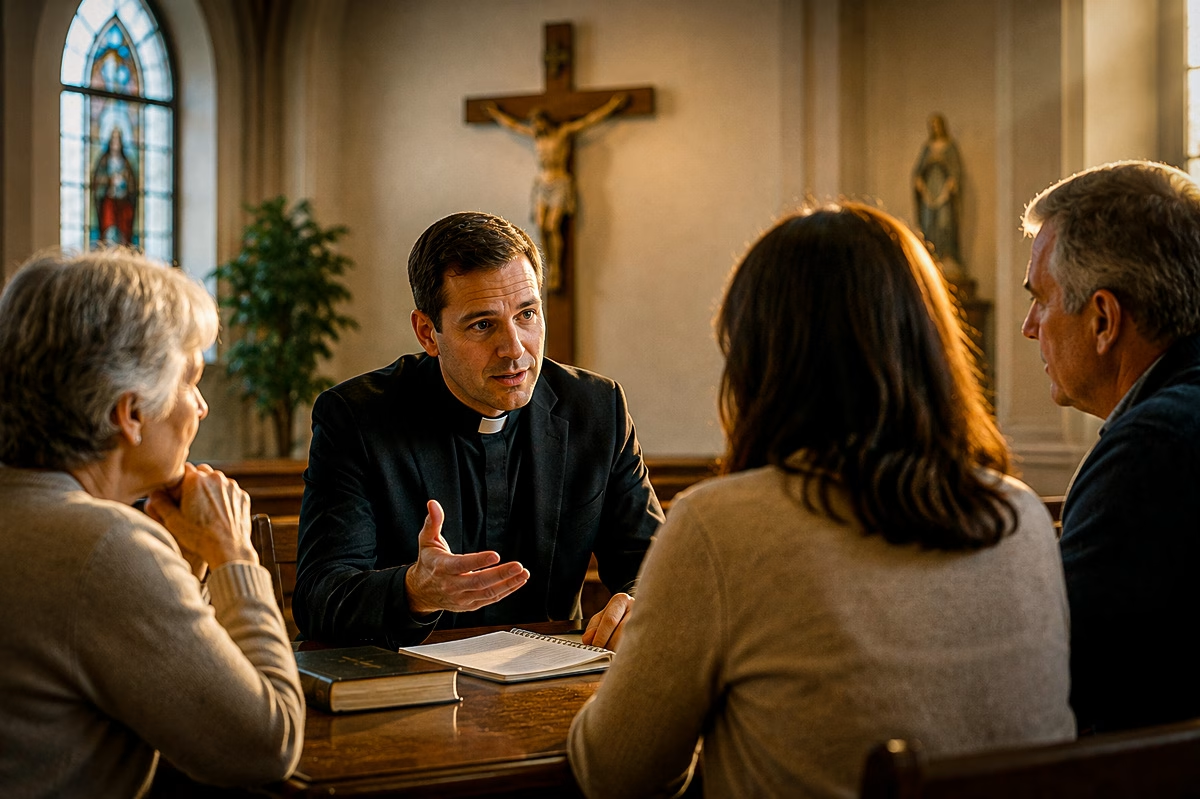
Every Catholic parish eventually confronts a quiet but persistent challenge: certain ministries become so closely identified with particular individuals that the work itself begins to feel like private territory. Long-serving volunteers may pour themselves into lecturing, coordinating the liturgy, leading the food pantry, organizing the annual festival, or guiding the youth group with admirable dedication. Over time, however, an unintended consequence often appears. Newcomers sense that the role is already “owned.” Offers of help are gently declined or met with resistance. When a pastor or ministry leader eventually asks the longtime servant to take a step back, perhaps for rest, renewal, shared leadership, or to open the door to others, the response can be offense, hurt, or even withdrawal. The ministry that once built up the Body of Christ risks becoming a source of division.
This is not a new problem, nor is it unique to any one parish. It is a human temptation that touches the heart of how we understand gifts, service, and belonging in the Church. A Catholic pastor or parish leader must therefore approach it not primarily as a managerial inconvenience but as a pastoral and spiritual opportunity. The response should be marked by charity, clarity, and formation drawn from the example of Jesus, the teaching of the Catechism of the Catholic Church, and the Church’s understanding of charisms and stewardship.
Every ministry is a trust held for a season, not a permanent possession.
Ministries as Charisms, Not Possessions
The Catechism is unambiguous about the nature of the gifts that animate parish life. Charisms, whether extraordinary or ordinary, are “graces of the Holy Spirit which directly or indirectly benefit the Church, ordered as they are to her building up, to the good of men, and to the needs of the world” (CCC 799). They are to be accepted with gratitude by the one who receives them and by the whole community, yet always measured by charity, “the true measure of all charisms” (CCC 800). Critically, “no charism is exempt from being referred and submitted to the Church’s shepherds,” whose task is not to extinguish the Spirit but to test and hold fast to what is good so that diverse gifts work together for the common good (CCC 801).
This teaching flows directly from St. Paul’s image of the Body of Christ in 1 Corinthians 12. The Spirit distributes gifts “to each one individually as he wills” for the common good, not for personal ownership or status. When a ministry is treated as private property, the charism is subtly distorted. The person who once received a gift for service begins to experience the ministry as an extension of the self. Asking that person to step aside then feels like a personal rejection rather than a communal act of stewardship.
Jesus’ Example: Service That Does Not Cling
The clearest model for addressing this situation is Jesus Himself. Throughout the Gospels He forms His disciples precisely by confronting the temptation to possess status, position, or exclusive roles. When the disciples argued about who was greatest, Jesus placed a child in their midst and declared that true greatness consists in becoming the least and the servant of all (Mark 9:33-37; Matthew 18:1-4). When James and John sought places of honor, He answered that “whoever would be great among you must be your servant, and whoever would be first among you must be slave of all. For even the Son of Man came not to be served but to serve, and to give His life as a ransom for many” (Mark 10:43-45).
The most striking enacted parable occurs at the Last Supper. Knowing that the Father had given all things into his hands, Jesus rose, laid aside his outer garments, took a towel, and washed the disciples’ feet, including the feet of the one who would betray him (John 13:1-17). Afterward He asked, “Do you understand what I have done for you? … If I then, your Lord and Teacher, have washed your feet, you also ought to wash one another’s feet. For I have given you an example, that you also should do just as I have done to you.” The Lord of the Church deliberately takes the lowest place so that His followers will never confuse leadership or long service with ownership.
A pastor who must ask someone to relinquish a ministry is, in a real sense, inviting that person into the same movement of self-emptying that Jesus modeled. The request is not a demotion; it is an invitation to deeper discipleship. When the individual experiences offense, the offense itself reveals the degree to which the ministry has become entangled with personal identity rather than remaining a free gift offered for the Body.
The goal is not to discard experience but to multiply it by sharing it.
A Pastoral Approach Rooted in Formation and Charity
How, then, should a pastor or ministry leader proceed? The first requirement is interior disposition. The leader must examine his or her own heart for impatience, favoritism, or the desire simply to “clear the decks.” Only then can the conversation be conducted in the spirit of the Good Shepherd who knows his sheep and seeks their good.
- Begin with gratitude and affirmation. Any conversation should begin by acknowledging the real good that has been done. Years of faithful service are a genuine contribution to the life of the parish. Naming that contribution publicly and privately honors the person’s generosity and reduces the sense that the request is a repudiation of their past work.
- Frame the issue theologically rather than administratively. Speak of charisms, stewardship, and the common good. Quote or paraphrase the Catechism and St. Paul. Explain that every ministry is a trust held for a season, not a permanent possession. Remind the person that the Holy Spirit continues to distribute gifts throughout the community and that new members need room to exercise their own charisms. This is not about competence or failure; it is about the Church’s nature as a living body in which many members share responsibility.
- Offer concrete pathways rather than abrupt dismissal. A sudden “you are done” almost always produces resentment. Better options include a planned transition period, co-leadership with a newer volunteer, a temporary leave of absence with the possibility of returning to a different capacity, or a shift to a mentoring role. The goal is not to discard experience but to multiply it by sharing it. In some cases, the person may discover fresh energy in a different area of parish life once the burden of sole ownership is lifted.
- Provide ongoing formation for the whole community. One private conversation will not solve a cultural problem. Pastors should periodically preach and teach on the nature of charisms, the spirituality of stewardship, and the example of Jesus the servant. Parish ministry handbooks or commissioning rites can include language that explicitly states ministries are time-limited and subject to pastoral review. When new volunteers are trained, they should hear from the beginning that their service is a gift offered to the community, not a role they will hold indefinitely. Over time this forms a culture in which rotation and shared leadership are expected rather than exceptional.
- Accompany the person through the transition. Offense often masks grief, fear of irrelevance, or a deeper wound. The pastor or a trusted spiritual companion should remain available. Prayer, the Sacrament of Reconciliation, and honest conversation can help the individual separate their worth from the particular ministry. Many longtime servants, once they release the grip of possession, discover unexpected freedom and a renewed sense of vocation.
- Model the same detachment in leadership. Pastors and staff themselves must be willing to share authority, solicit input, and step aside when appropriate. A leader who clings to control cannot credibly ask others to loosen their grip. The same spirit of humble service that Jesus required of the disciples applies first to those who hold pastoral office.
No one is indispensable except Christ Himself.
The Fruit of Faithful Stewardship
When this approach is followed with patience and consistency, several goods emerge. Broader participation strengthens the parish’s resilience; no single ministry collapses when one person is unavailable. Newer members experience genuine welcome and discover their own gifts. Long-serving volunteers are protected from burnout and from the subtle idolatry of identifying their spiritual worth with a particular role. Most importantly, the parish more clearly reflects the Body of Christ, in which every member contributes according to the Spirit’s distribution, and no one is indispensable except Christ Himself.
The challenge of possessive ministries is ultimately an invitation to conversion, for the individual, for the leadership, and for the whole community. It calls everyone back to the fundamental truth that all we have received is gift, that ministry is a form of stewardship, and that only lasting greatness is found in becoming the servant of all. In following the path marked by Jesus’ towel and basin, by the Catechism’s teaching on charisms, and by the Church’s call to shared responsibility, pastors and leaders help their people move from possession to participation, from ownership to offering. In that movement the parish becomes more fully what it is meant to be: a living communion ordered to the glory of God and the salvation of souls.
In short, the pastor does not cease to be a spiritual father when he exercises supervisory responsibility; he exercises that fatherhood more completely. Jesus corrected those closest to him because he loved them and the mission. The Church’s tradition of fraternal correction, the canons on pastoral governance, and the practical demands of just employment all converge on the same conclusion: timely, charitable, clear conversations about performance are not a secular add-on but an expression of the pastor’s vocation. Embracing them frees the pastor, serves the staff member’s dignity and growth, and protects the parish’s capacity to proclaim the Gospel effectively.
Deacon Patrick Stokely
Saints Peter and Paul Parish
West Chester, PA