Many everyday Catholics feel confused about what they are required to accept as true. The Church speaks of Scripture, Tradition, and the Magisterium as working together, yet it is not always clear where the lines fall between binding teaching and areas of legitimate freedom. The answer is simpler than it first appears once we understand how these three gifts fit together and the different levels of authority in Church teaching.
One Deposit of Faith, Three Means of Transmission
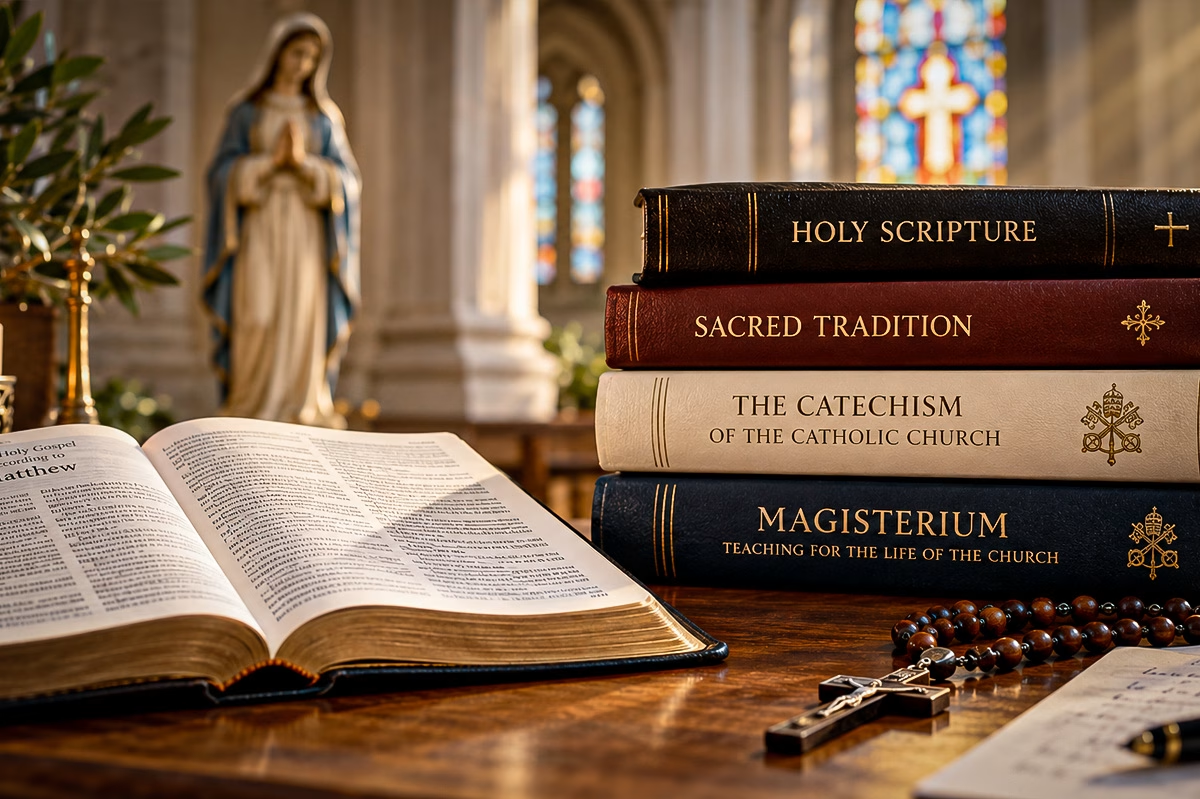
God has revealed Himself fully in Jesus Christ. That revelation, the deposit of faith, is not a collection of scattered ideas but a single living reality. The Church receives and hands on this deposit through two complementary channels: Sacred Scripture and Sacred Tradition.
Sacred Scripture is the Word of God written down under the inspiration of the Holy Spirit. It is the speech of God put into human words. Sacred Tradition is the living transmission of that same Word. It includes the oral preaching of the Apostles, their example, the Church’s worship, and the way the faith has been lived and taught from generation to generation. Tradition is not a set of extra rules invented later; it is the full reality of the Gospel as it was first handed on and continues to be handed on in the life of the Church.
Scripture and Tradition are not two separate sources of revelation that sometimes contradict each other. They flow from the same divine wellspring and move toward the same goal. The Church does not draw her certainty about revealed truths from Scripture alone. Both must be accepted and honored with equal devotion and reverence. 
Scripture and Tradition are not two separate sources of revelation that sometimes contradict each other.
Neither Scripture nor Tradition interprets itself in isolation.
The task of authentic interpretation belongs to the Magisterium, the living teaching office of the Church, exercised by the Pope and the bishops in communion with him. The Magisterium is not above the Word of God. It is its servant. It listens to the deposit of faith, guards it, and explains it faithfully under the guidance of the Holy Spirit. All three, Scripture, Tradition, and Magisterium, are so connected that one cannot stand without the others. Together they serve the salvation of souls.
A helpful image is a three-legged stool. Remove any leg and the whole structure collapses. Catholics do not choose between the Bible and the Church, or between personal reading and official teaching. They receive the faith through all three working in harmony.
The Magisterium is not above the Word of God. It is its servant.
Levels of Teaching: What Is Binding and What Is Not
Not every statement that comes from a bishop, a papal document, or a theological book carries the same weight. The Church distinguishes carefully between different levels of teaching. Understanding these levels removes much of the confusion about what a Catholic is bound to believe.
- Dogmas (truths of divine and Catholic faith): These are truths that the Church teaches as divinely revealed and proposes for irrevocable belief. They may be defined solemnly by a Pope speaking ex cathedra or by an ecumenical council, or they may be taught by the ordinary and universal Magisterium when the bishops throughout the world, in communion with the Pope, hold a doctrine as definitive. Examples include the Trinity, the divinity of Christ, the Real Presence of Christ in the Eucharist, the Immaculate Conception, and the Assumption of Mary. These require the full assent of faith. To deny them knowingly and obstinately is to place oneself outside full communion with the Church.
- Definitive doctrines (to be held definitively): These are teachings that are not themselves revealed but are so closely connected to revelation that the Church teaches them infallibly for the sake of safeguarding the faith. They also require firm and definitive assent. Examples include the teaching that only baptized men may be ordained to the priesthood and certain moral truths such as the intrinsic evil of abortion or euthanasia when proposed in this definitive way.
- Authoritative but non-infallible teaching: Most ordinary teaching of the Pope and bishops falls into this category. Encyclicals, apostolic exhortations, and many statements of local bishops belong here when they propose doctrine on faith or morals without intending to define it infallibly. The faithful are called to give religious submission of intellect and will, an interior assent that is real and serious, even though it is not the absolute assent of faith. This submission is not blind obedience; it is the disposition of someone who trusts that the Church’s pastors, guided by the Holy Spirit, are teaching in continuity with the deposit of faith. Legitimate questions and further study remain possible, but public dissent that undermines the teaching is not.
- Theological opinions and prudential judgments: Here the Catholic enjoys genuine freedom. Theologians may propose different explanations of how a dogma is best understood. Popes and bishops may offer prudential advice on political or economic questions where the Gospel applies but no definitive moral principle is at stake. Catholics may respectfully disagree with such opinions provided they remain within the bounds of faith and charity. For example, different Catholics may reach different conclusions about the best practical policies for addressing poverty or environmental concerns, as long as they accept the underlying moral principles the Church teaches.
The key is to notice the intention of the teacher and the manner of the teaching. Not every sentence in a papal document is meant to bind the conscience in the same way. Careful reading of the text, attention to the history of the doctrine, and consultation of reliable explanations help distinguish the levels.
They are not obstacles to faith; they are its secure foundation.
Everyday Implications
In practice this means a Catholic is bound to believe everything the Church teaches as belonging to the deposit of faith, whether found in Scripture, clarified by Tradition, or defined by the Magisterium. At the same time, the Church leaves wide room for legitimate diversity of opinion on many secondary questions. Personal Bible reading is encouraged, but private interpretation that contradicts the living Tradition and the Magisterium is not the Catholic way. Devotions, theological schools, and preferred spiritualities may differ widely; the core of the faith does not.
When confusion arises, the ordinary path is simple: consult the Catechism of the Catholic Church, the documents of the Second Vatican Council (especially Dei Verbum), and trustworthy teachers who explain the faith in continuity with the Church’s living Tradition. The goal is not to police every opinion but to remain rooted in the one faith handed down from the Apostles.
Scripture, Tradition, and the Magisterium are gifts given so that ordinary believers can know the truth with confidence. They are not obstacles to faith; they are its secure foundation. By receiving them together, Catholics inherit the fullness of what God has revealed and are freed to live that revelation with both fidelity and genuine freedom.
Deacon Patrick Stokely
Saints Peter and Paul Parish
West Chester, PA